Finance · Top Story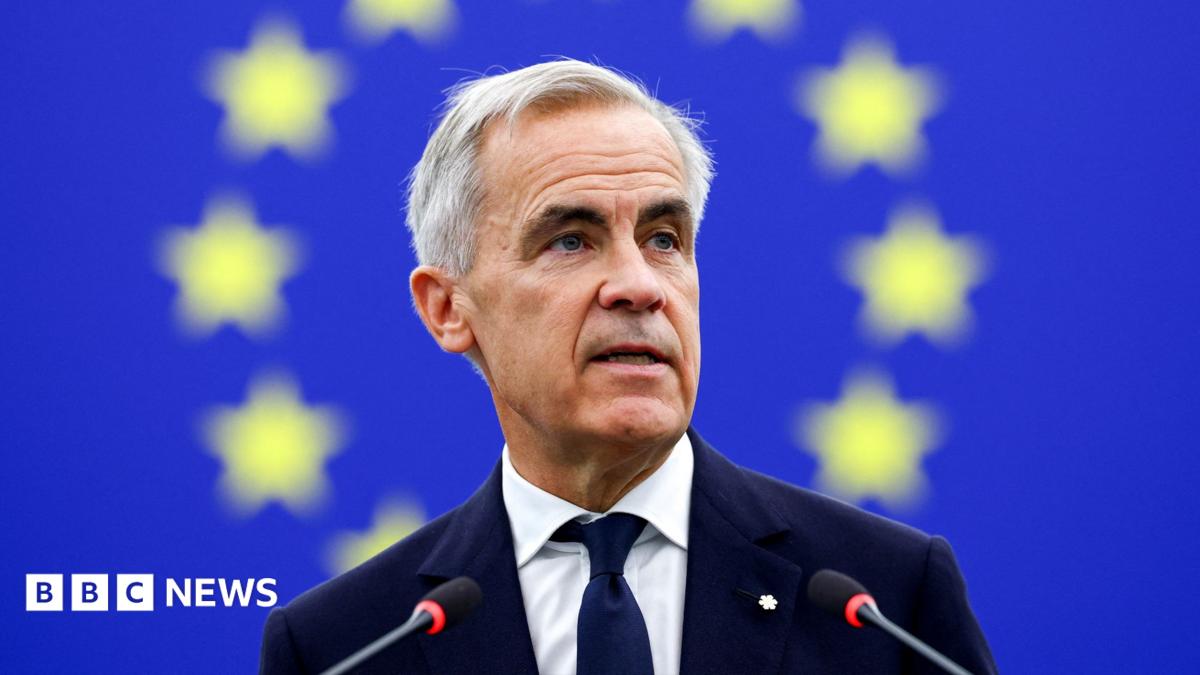
Tariffs are being used to 'exert pressure', says Canadian PM published at 11:04 BST Image source, EBU Continuing his address to the European Parliament, Carney says today our societies are being "battered by new storms" - including climate change, "the erosion of democratic norms [and] the weaponisation of trade". The Canadian prime minister - nodding to US President Donald Trump's use of tariffs - says: "Economic integration is now being weaponised, tariffs being used to exert pressure. "Financial mechanisms have been used for coercion.
Supply chains constitute weak points to be exploited." Canada and the EU 'are not fair weather allies' - Carney published at 11:00 BST Carney says Canada and the EU have bonds "deeply rooted in our lands", and speaks about the shared history between Canada and Europe. The Canadian prime minister lists off things he says were "carried back and forth across the Atlantic for centuries" - including seeds, values, ideas and trade. Carney adds that Canada and the EU "are not fair weather allies, we do not pursue zero-sum deals".
He says both share the "same unwavering dedication" to the rule of law, human dignity, individual freedom and democracy. He adds that a "strong economy is not an end in itself but a means to a just society". Response to 'geopolitical rupture' must include a 'new dimension', says Carney published at 10:50 BST Image source, EBU Mark Carney begins his address to the European Parliament.
Delivering his opening remarks in French, he thanks the parliament for the honour of allowing him to addressing them. The Canadian prime minister says he is going to speak today about how the response to the "current geopolitical rupture" must include a "new dimension". Canadian PM Carney about to speak - watch live published at 10:40 BST Image source, EBU Canadian Prime Minister Mark Carney has just walked into the chamber at the European Parliament in Strasbourg, where he'll shortly address members.
Afterwards Carney will hold a press conference alongside European Parliament President Roberta Metsola. We'll bring you all the key moments here, and you can watch live at the top of the page. Canada and the EU explore closer links - with Carney due to address European Parliament published at 10:16 BST Katie Williams Live reporter Image source, Reuters Image caption, Canadian Prime Minister Mark Carney shakes hands with a member of the European Parliament while attending yesterday's State of the Union address There has been a lot of discussion in recent days about the future of Canada's relationship with the European Union.
Canadian Prime Minister Mark Carney said on Sunday that Canada was seeking a "unique alliance" with the bloc. European Commission President Ursula von der Leyen said yesterday she wanted to work on "opening the door" for Canada to become an "associate member" . It's not clear what exactly the future relationship would look like - the "associate member" status doesn't currently exist and, if agreed, could take years to implement - but it's clear both are seeking closer ties.
As our Europe editor, Katya Adler, writes, US President Donald Trump is the unintentional matchmaker here. The relationship between Canada and the US - often seen as the closest of partners - has soured in recent months, with an ongoing trade dispute between the neighbours. Speaking to reporters last night, Trump called the prospect of Canada becoming an associate member of the EU "laughable", and threatened to impose "very serious tariffs" on Europe if he interprets any move as happening with "a bad intention".
We should hear more shortly, with Carney due to address the European Parliament in Strasbourg from around 11:30 local time (10:30 BST). You'll be able to watch live at the top of the page. Getting agreement on Canada's 'associate membership' from all EU states will be tough published at 09:50 BST Katya Adler Europe editor "Associate membership" of the EU is what the European Commission president has offered Canada but - and it’s a big but - it can only be signed off if all 27 EU member states agree.
And that will be tough. Germany’s proposal to offer associate membership to Ukraine, which longs to be under the EU umbrella, was rejected by other countries in the bloc back in May. Objections are manifold - some feel it’s unfair to create a special status for 'political expedience' for Canada or Ukraine when others like Macedonia or Bosnia have been queuing up for years to join.
Others fear a possible backlash from US President Donald Trump - even new tariffs, as he suggested last night - if they hug Canada too tight. We're talking about ways to describe the work we're doing, says Canada's EU ambassador published at 09:29 BST Image source, Getty Images Canada's ambassador to the EU says the two partners have been "talking about a lot of different ways in which you can describe the work we’re doing". Referencing European Commission President Ursula von der Leyen's use of the term "associate member", Jonathan Wilkinson says: "We're not there.
"It's an opportunity for us to talk about that, but we're really much more focused on getting concrete results." Speaking to reporters, he says the focus of discussions is "moving forward with some of the specific initiatives that we have proposed and they have proposed back to us". The initiatives which they "collectively agree on" will be announced at an EU-Canada summit in October, he adds. Donald Trump is the unintentional matchmaker between Canada and the EU published at 09:15 BST Katya Adler Europe editor A dizzying potpourri of proposals is making waves across Europe right now.
Associate EU membership for Canada, a European Security Council that could include Canada and the UK, and Canada and Britain's competing visions for an allied military financing bank. Canada’s prime minister is in town - Strasbourg - addressing the European Parliament today after popping over to Liverpool last night for a chat with UK Prime Minister Andy Burnham. Mark Carney hopes to gather together like-minded nations in defence, tech and AI, and economic and energy security.
In public, no leader involved in discussions is mentioning the US president by name, but Donald Trump is the unintentional matchmaker here. Now in his second term, America’s closest allies feel they can no longer fully rely on Washington to respect trade deals or have their back in security terms. That, and the economic threat felt from China, is bringing them closer.
Carney's 'elbows up' approach to Trump's trade threats published at 09:09 BST Image source, EPA Mark Carney became prime minister in March 2025, with a call for "elbows up" in response to Donald Trump - an ice hockey term for an aggressive approach. The former Bank of England governor has pledged to fight for Canada in the wake of threats from the US president, who had imposed tariffs on Canada and repeatedly referred to it as the "51st state". Carney has been praised by some for his strong rhetoric, including a speech at the World Economic Forum in January where he warned the old world order was "not coming back" and urged the so-called middle powers to "act together".
He has also stood up to Trump on trade, imposing counter tariffs on the US . Part of his effort to reduce Canada's reliance on the US has focused on attracting investment. He has pledged to attract C$1tn ($720bn; £530bn) in the next five years by cutting red tape and developing mining, energy, technology and infrastructure projects.
And at a summit a few days ago , he pitched Canada as a "safe harbour" for investors in an era of geopolitical uncertainty. But some critics protesting at the summit accused him of organising a "great Canadian sell-off" of public resources and infrastructure. "Half the buyers that he has invited here to Toronto are American," said Kai Nagata from advocacy group Dogwood.
"Let's be clear, every piece of our country that we sell off to American billionaires brings us closer to becoming the 51st state." Carney joins fellow Everton fan Burnham at match published at 08:49 BST Image source, EPA/Shutterstock Ahead of his address to the European Parliament later, Canadian Prime Minister Mark Carney joined UK Prime Minister Andy Burnham to watch their beloved Everton play. The leaders held a bilateral meeting yesterday, which lasted about 45 minutes, at Everton's Hill Dickinson Stadium in Liverpool, before watching the team's Carabao Cup third round win against Wolves. Downing Street said the prime ministers discussed the importance of building similar close ties with European partners, particularly on trade and defence, during their meeting.
During the game, both leaders could be seen cheering on their team from the stands. Burnham said ahead of the match that the evening was special for a “personal reason”, as there was a tribute to his father Roy, who died earlier this week. Both men are big Toffees fans, and Carney told reporters the first Everton match he attended was the 1989 FA Cup semi final - a game Burnham has also spoken about attending.
Image source, PA Media Both the EU and Canada are searching for new best friends published at 08:35 BST Katya Adler Europe editor Diversify, diversify diversify. That’s the current thinking in Canada and the EU - the US is traditionally the number one trade partner for both. Canadians and Europeans used to look to Washington first when it came to defence too.
But Donald Trump has changed all that - with trade tariffs and a perceived ambivalence towards Nato and Arctic security from a Russian threat. Now the EU and Canada are searching for BFFs - that's best friends forever - elsewhere. Yesterday, the President of the European Commission Ursula von der Leyen took the unprecedented step of offering Canada associate membership of the EU.
What that means in practice is unclear - though there's a bilateral interest to work closer in digital technologies, energy and security, and to promote multilateral global governance when it comes to trade. The UK will be watching closely. A summit designed to reset EU-UK relations has just been postponed - again - over political differences.
What is an EU 'associate member'? published at 08:21 BST Image source, NurPhoto via Getty Images As we reported in our previous post, Ursula von der Leyen told the European Parliament on Wednesday that she wanted to work with Mark Carney on "opening the door for Canada to be the first associate member of the EU". But the status of "associate member" of the EU doesn't currently exist - and, if agreed, the process could take years. It's not clear exactly what form this membership would take, but von der Leyen laid out a number of different sectors where they could form closer ties.
The idea has been floated in the past - for example, German Chancellor Friedrich Merz suggested earlier this year that Ukraine could be granted the same status. But it was met with pushback from some member states. The bloc is currently comprised of 27 countries - while nine others are official candidates pursuing full EU membership, but it's a years-long process from start to finish.
A free-trade agreement was struck between the EU and Canada nearly a decade ago, but 10 members are yet to ratify the deal. Some would also prefer to build on existing defence and trade agreements rather than create a new form of membership for Canada. 'This is not a partnership against anyone else', says von der Leyen published at 07:58 BST Image source, AFP via Getty Images In her wide-ranging State of the Union address yesterday, European Commission President Ursula von der Leyen said “this is not a partnership against anyone else, but for our common strength". Her comments did not mention the US by name - the country is currently embroiled in a trade dispute with Canada.
With Canadian Prime Minister Mark Carney watching on, von der Leyen said she wanted to open the door for his country to become the EU's "first associate member". "We must urgently re-imagine our partnerships," she said, citing tech, defence and energy critical minerals as areas where they could "join forces". Separately, von der Leyen also expressed a desire to build a European Security Council - including the EU and its partners, such as the UK, Ukraine and Canada.
How US and Canada trade talks derailed published at 07:47 BST Image source, Reuters Image caption, Trump and Carney, pictured at a meeting in June Canada and the US have been locked in an escalating trade war, following the breakdown of trade negotiations in late August. Negotiators had been engaged in intense talks since July - but broke down at the last minute. Both sides blamed each other for torpedoing the tentative deal.
Canadian Prime Minister Mark Carney said "last-minute changes in the US proposed terms were unfair, uneconomic, and called into question the reliability of any deal". US trade representative Jamieson Greer said Canada had "declined to finalise" the agreed terms, despite the "US offer to Canada to receive the best treatment of any major exporter to our market". The US then imposed tariffs on key Canadian sectors including steel, aluminium and lumber, and introduced an additional 50% levy on about C$28bn ($20bn; £15bn) of Canadian goods.
In response, Ottawa slapped levies of up to 50% on C$28bn ($20bn; £15bn) of American products, from steel to furniture to cotton T-shirts. Carney said the US "asked too much and they offered too little", adding that Canada was retaliating with tariffs "reluctantly" to protect its interests. Meanwhile, Trump said Canada wants "the benefits of being a state, without being one" - echoing his repeated references to turning Canada into the 51st US state.
Carney's new love-in with the EU has everything to do with Trump published at 07:38 BST Katya Adler Europe editor Image source, Reuters "Wouldn't it be lovely if Canada was the 28th state of the European Union rather than the 51st state of the United States?" asked Finland's President Alexander Stubb this summer. The question was rather tongue-in-cheek. US President Donald Trump, who is currently locked in an escalating tariff tussle with Ottawa, has, on a number of occasions, declared his ambition to make Canada the 51st American state - causing deep offence amongst many Canadians.
But Stubb put his finger squarely on the pulse of deepening EU-Canadian relations. And in a speech on Wednesday, European Commission President Ursula von der Leyen said she wanted to work "on opening the door" for Canada to be the EU's "associate member" - which would involve closer ties on various sectors including manufacturing and energy. The catalyst for this very public, ardent new love-in is Donald Trump.
Just the other day, the US president posted a map of North America on his Truth Social site, including Canada and Greenland - a territory that's part of EU country Denmark - all overlaid with the US flag. Trade negotiations between the US and Canada also broke down late last month, and European countries, which have been hit by their own Trump tariffs, have privately watched the spat play out with a mixture of interest and, for many, admiration. Read more analysis from Katya Adler on whether European politicians are ready to risk the wrath of Trump for Carney Prospect of Canada becoming an EU associate member 'laughable', Trump says published at 07:37 BST Speaking to reporters last night, US President Donald Trump called the prospect of Canada becoming an associate member of the EU "laughable".
He said: "Look, the whole thing with Canada, Canada's been a terrible trade partner." Describing the move, if it happens, as a "hostile act", Trump said he would put "very serious tariffs or stop trading with Europe on many things". "If it's a good intention, that's fine. If it's a bad intention, we'll put very heavy tariffs on Europe," he said.
Trump threatens 'serious tariffs' on EU over proposal to make Canada 'associate member' published at 07:35 BST Image source, Pool US President Donald Trump has threatened to take action against the European Union (EU) if it moves forward with a proposal to make Canada its first "associate member". Canada's relationship with the US - long considered its closest partner - has soured in recent months, and Canadian Prime Minister Mark Carney has been developing closer relations with the EU. Last week, he said he's seeking a "unique alliance" with Brussels.
And, in her State of the Union address yesterday, European Commission President Ursula von der Leyen’s said she wanted to work on “opening the door” for Canada, which would involve closer ties in various key sectors. Speaking to reporters last night, Trump said: "If they do that, if I think it's at all a hostile act, I will put very serious tariffs or stop trading with Europe on many things. "And so if they do that, if Europe does that with a bad intention, if it's a good intention, that's fine.
If it's a bad intention, we'll put very heavy tariffs on Europe." Carney is due to address the European Parliament in Strasbourg, France later this morning - he's attending the parliament's plenary meeting as a guest of honour. The Canadian prime minister's speech is set to begin at 11:30 local time (10:30 BST), and you’ll be able to watch live at the top of the page.
Source: BBC